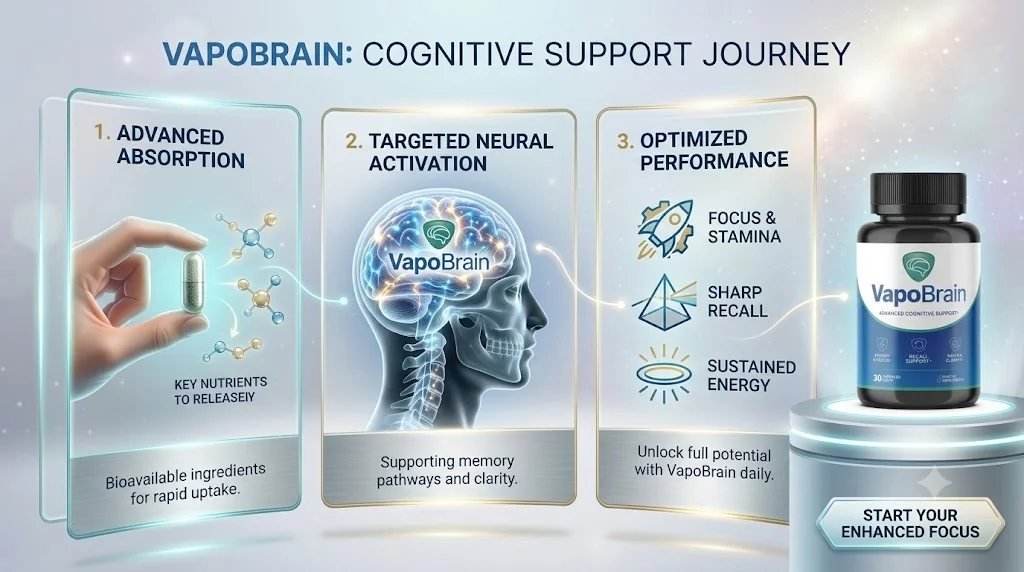
Quick answer: VapoBrain's graphic describes three stages: advanced absorption, targeted neural activation and optimized performance. In real terms, huperzine A raises acetylcholine within hours, Bacopa may improve recall after about 12 weeks, and the overall effect is likely modest. No trial has tested VapoBrain itself.
Acetylcholine: the learning messenger
Acetylcholine helps nerve cells in the hippocampus encode new memories. Huperzine A blocks the enzyme that breaks it down, so levels stay higher for longer. This is the same principle as prescription dementia drugs, which is why the two should not be mixed casually.
Consolidation: why Bacopa is slow
Bacopa's bacosides appear to support communication between nerve cells over time. In trials, the difference from placebo only became clear after 8 to 12 weeks, and it was small.
Blood flow and membranes
Ginkgo relaxes blood vessels and thins the blood slightly; phosphatidylserine is part of the membranes that nerve signals travel across. Both make sense on paper, but large trials of ginkgo did not slow memory decline.
The three stages, fact-checked
| Brand stage | What is known |
|---|---|
| Advanced absorption | No absorption data published. |
| Targeted neural activation | Plausible for huperzine A and Bacopa. |
| Optimized performance | Not measured for VapoBrain. |
Bottom line: the mechanisms are real, the effect size is likely small and slow, and the unknown doses make it impossible to predict more.
See the current VapoBrain offer
Frequently asked questions
General information, not medical advice. VapoBrain is a dietary supplement and is not intended to diagnose, treat, cure or prevent any disease.